FutureWire - futurism and emerging technology

Monday, February 28, 2005

Global "Digital Divide" Narrows

A study by the World Bank has found that the digital capabilities of the developing world are rapidly catching up to those of the developed world. Half the world now has access to land-based phone lines, and 77% have access to mobile networks. This surpasses a UN goal of 50% access by 2015. Africa in particular has become a booming mobile phone market, leapfrogging over traditional fixed-line telecommunications.

This is good news not only for people in developing countries, but the tech industry in general, as rapid growth in these regions will fuel the telecom business and offset more mature markets where growth is plateauing.

Source: Reuters (Yahoo!)

Paper from Elephant Dung

If you can get past the "yuck factor," you must admit that making paper out of elephant dung -- or any other type of excrement -- has its upsides. The raw material, after all, is plentiful. Harvesting it is inexpensive and doesn't harm the environment, and it needs to be disposed of anyway. The end products, from stationery to notebooks to boxes, are even attractive:


This is true "thinking outside the box" (pun partially intended), and shows that not all future technology has to be "high tech."

Source: Core 77, Future Feeder

When Mobile Becomes Essential

How would you feel if you lost your mobile device? Of course you'd be upset or irritated, but would you feel that a part of your life were missing? Increasingly, many mobile users would feel that a part of their world would be gone if they didn't have access to their devices.

Says researcher Michael Hulme, "If we go back five years, [mobile devices] used to be fairly functional. Today we're moving towards a real time of dependency, where if we lose our mobile we begin to feel cut off from our network of friends, cut off from our contacts, and absolutely disabled. The other thing is that the mobile is very much a device of control. We are using it to control our relationships with others, how others contact us, and increasingly to control information."

A sign of a maturing technology is a certain level of dependence on it. It becomes so deeply ingrained in the way we function that losing it is incredibly disruptive. It also speaks to the growing functionality of mobile devices. As cell phones and PDAs converge, they become exponentially useful -- and, obeying Metcalfe's Law of expanding networks, the more people we know with mobile devices, the more empowering the network becomes.

Another sign that mobile devices are maturing is the arrival of second-generation mobile applications. As with the early Internet, much of the early mobile technology was experimental or "gee whiz" in nature, and not well thought through. Now, though, developers are applying lessons learned to applications that meet real user needs.

Yet one more sign that mobile devices have moved from the realm of elective to essential: the Australian government is lending cell phones to the homeless to help them find jobs.

Sources: BBC, Smart Mobs

Gangs Going Global

Gangs are back in the news now that First Lady Laura Bush has made combatting them a personal priority. They are also attracting the attention of the FBI, which is taking a new look at gang dynamics, even though gang numbers are declining in the US.

A growing concern among law enforcement is not gangs' raw membership, but the nature of their reach. The Internet is providing gangs with a tool for worldwide networking, recruitment and international alliances. One extremely violent gang in particular, Mara Salvatrucha (MS), has roots in El Salvador but has spread stateside from the Salvadoran community in Los Angeles to Virginia. Even more concerning to the FBI, some MS members reportedly have links to al-Qaeda. As a result, gangs are becoming a focus of counterterrorism as well as anti-crime measures.

Sources: The Economist, Futurismic

Pervasive Patient Monitoring

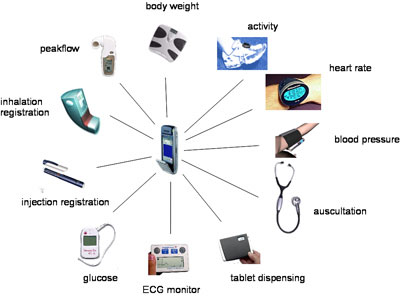
For at-risk patients who need their care monitored round-the-clock yet aren't sick enough to require hospitalization, pervasive monitoring is a solution to help both patients and doctors. Pervasive monitoring goes beyond traditional telemedicine to provide clinicians with a real-time portrait of patients' conditions.

IBM is developing a "mobile health toolkit" that links a variety of monitoring devices via Bluetooth and Java-based middleware.


The system can monitor a variety of conditions, including blood pressure, weight, glucose, and whether a patient takes his or her medications on time. The system uses open architecture, so that new devices can be added easily as they become available.

Source: ERCIM News

Talking Drug Labels

A Thailand firm has developed a system that allows patients to listen to medicine labels to learn prescribed doses, interactions and warnings. The device can also "speak" the information in multiple languages.

The system combines an RFID chip on the label with a listening device that correlates the medicine with an information database. The system has promising applications for visually impaired patients and for those who do not read the language in which the medicine label is printed.

Source: we make money not art

Friday, February 25, 2005

The Future, Past Tense

For a fun Friday afternoon diversion, visit David Szondy's Tales of Future Past, an archive of "future" visions of past eras, complete with vintage artwork and insightful commentary (much of it noting the practical reasons why these futures never came to pass). If you're wondering what happened to the flying car, robot servant, domed city or condo on Venus you were promised way back when, this is the place to look.


For those old enough to remember the '60s TV show Thunderbirds, the site also contains some great images.

Source: Future Feeder

Deliberative Democracy

The rise of blogs and Internet-based fundraising during the 2004 Presidential campaign may only be the beginning of a new approach to democracy that is potentially transforming. Called deliberative democracy, it emphasizes shared knowledge and collaborative decision-making above traditional top-down politics. Technology plays a role, to be sure, but the emphasis is on the personal connections, consensus decision making, and free exchange of resources.

Perhaps, in our current contentious political environment, deliberative democracy may offer some solutions. Exactly how we would reconcile deliberative democratic principles in representative forms of government -- in which elected officials deliberate (theoretically) on the behalf of their constituents -- remains to be seen. Are there areas in which deliberative democracy would work better than in others? How, for instance, would deliberative democracy respond to a national emergency or a military action, where deliberation could cause costly delays? The Co-Intelligence Institute and the website Innovations in Democracy has links to dozens of resources and deliberative democracy experiments.

Source: WorldChanging

Turn On, Tune In, Get Healthy

Most people don't consider possible medical benefits of LSD, peyote, MDMA (aka "ecstasy") and other hallucinogenic drugs. However, before advocating the recreational benefits of psychedelics, Dr. Timothy Leary first experimented with them as a way to treat alcoholism. Now, a new generation of scientists is studying how psychedelic drugs could be used to treat everything from substance abuse to severe migraine headaches.

Research into the health benefits of psychedelics, of course, largely dried up when the substances were criminalized in the late 1960s. Since then, research groups advocating study of the health benefits of psychoactive drugs have been petitioning governments around the world for changes to the law.

A study of peyote use among residents of a Navajo reservation (who are permitted by US law to use the drug for religious purposes) found that peyote is safer than previously believed. It also showed promise in preventing recovering alcoholics on the reservation from relapsing. Similar studies have been conducted in Russia, where access to some psychedelic drugs was legal until recently.

Source: New Scientist

U.S. House Approves Electronic ID Card Standard

Earlier this month, and with relatively little fanfare, the US House of Representatives approved the Real ID Act of 2005, which would set a national standard for issuing identification cards such as driver's licenses. To comply, all cards would have to include a digital photo, anticounterfeiting measures, and "machine-readable technology" that could be either a magnetic strip, barcode or RFID chip. The Department of Homeland Security will draft the specific requirements later.

The bill also requires that state DMVs link their databases to create a searchable national record. States failing to comply could lose highway funds.

Compliant cards would be required for entry into airports, courthouses, national parks and any other facility to which the federal government controls access. Such cards will invariably become the "gold standard" for personal identification, meaning that having a vaild card will be essential for conducting a host of activities, regardless of whether they involve the federal government.

The Bush White House strongly supports the Real ID Act, making it a near certainty that President Bush will sign the act into law once it passes the Senate.

Needless to say, the bill has evoked strong opposition among civil libertarians, gun activists and states-rights advocates. The Electronic Frontier Foundation has posted numerous resources and arguments against such a national ID initiaitive.

Sources: C|Net, Futurismic

Thursday, February 24, 2005

Chillin' for 30,000 Years

Life is at once a delicate and a remarkably resilient thing. Take, for instance, Carnobacterium pleistocenium, a bacterium from the age of wooly mammoths. Recently, US scientists published a paper describing how they thawed out a sample of this organism that had been frozen for 30,000 years in Alaska permafrost -- and how it began swimming around as if it had been born yesterday!

Such tolerance to deep freezing raises the possibility that life could be preserved in extremely harsh climates -- most notably, Mars, where frozen oceans were recently discovered. Could primitive life forms lie frozen just under the Martian surface, waiting for an eventual thaw? Could the same be said of other worlds, such as Jupiter's moon Europa? If nothing else, this chilled-out bacterium may be able to teach us something about how life could be preserved at very low temperatures over long periods.

Source: CNN.com

Doctors Use Camera Phones for Telemedicine

Physicians in Switzerland are studying the use of camera phones for diagnosing serious wounds in patients in remote locations. A nurse, for instance, could take a picture and send it to a doctor who otherwise could not reach the patient.

In experiments, the diagnoses from doctors who viewed injuries via camera phone agreed with those from doctors who saw the injuries in person. Before being used in the US, HIPAA and other electronic privacy issues would have to be addressed, but the potential exists for making "virtual house calls."

Source: CNN.com

Wednesday, February 23, 2005

Consumers Want Cell Phones With Style

It's no longer enough to have a cell phone with the latest technology or the most features. A recent poll conducted by IDC found that the majority of those surveyed believe that status and style are the most important considerations when choosing cell phones.

Sleek design, fashion labels like Baby Phat and Escada, and celebrity endorsements all help to give cell phones a "cool" cachet. Advertising -- both direct and indirect -- also sways opinion, as the image of talking on a cell phone is replacing cigarette smoking as a way to imply coolness. Maybe the American Lung Association ought to market a line of designer phones...

Sources: Wired, Techdirt

Robots that Truly Walk Like Humans

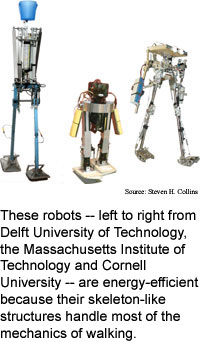
One of the toughest challenges in robotics is building humanoid forms that can walk upright on two legs like humans. Now, researchers at Delft University in the Netherlands, Cornell University and MIT may have solved the problem.


The key is a line of technology called passive-dynamic walking, which uses gravity to drive a bipedal device down a slope. Passive-dynamic technology does not attempt to control all joints in the movement, but allows most of the joints to hang free.

The robots developed by the three universities solve a variety of other problems related to balance, stride, foot size, stopping, steering, shock absorption and even walking backward. In addition to use in humanoid robotics, the research shows promise in helping to develop better prosthetic legs and feet. However, practical applications are likely at least 20 years out.

Source: Technology Research News

UN Releases Latest World Demographic Trends

The United Nations has released its latest "World Demographic Trends" report, current up through 2004. Among the more interesting statistics:

  • The current world population stands at about 6.5 billion people, will likely reach 7 billion by 2012, and should peak at 8.9 billion by 2050, assuming birth and mortality rates remain on track.
  • The vast majority of the world's population in 2050 will live in the developing world.
  • Ten percent of the world's population is aged 60 or older this year. This demographic will more than double by 2050.
  • By 2030, 60% of the world's population will live in cities.
  • Tokyo, currently the world's most populous city, will remain so in 2015. Mumbai (Bombay) and Delhi in India will surpass Mexico City in size to become the second and third largest cities, respectively. The New York-Newark metro area -- America's most populated city -- will be the world's sixth most populated city in 2015.
  • Of the 22 most populated cities in 2015, only four will be in North America or Europe.

Source: WorldChanging

Satellite Work Centers Ease Commutes

Organizations that want to give their employees more commuting flexibility are considering opening satellite offices that give workers office space while lessening their commuting time. Many of these offices are designed for telecommuters who mainly work at home or on the road, and who use them only when needed. The offices contain full Internet, video conferencing and electronic whiteboard technology, and offer a variety of office setups, from traditional closed-door offices to "hoteling" arrangements for those who need only a place to sit temporarily. The Canadian firm SuiteWorks is one company specializing in constructing satellite office space for teleworkers.

Source: Herman Trend Alert

Tuesday, February 22, 2005

Japanese Smart Phones, Payment Systems Converge

Early next year, Japanese commuters will be able to pay for their train fare by cell phone, when the Suica electronic payment system for trains starts supporting Sony IC chips embedded in DoCoMo phones.


Suica, a widespread smart-card system for paying train fare, was rolled out by the East Japan Railway Co. three years ago. By making Suica compatible with Sony's FeliCa IC chip, the system links two important e-payment systems, and could lead to more ways to pay for products and services via cell phone. Testing of the system will begin this March.

Source: CNN.com

SMS Disrupts the Greeting Card Business

When you care enough to send the very best... text it!

The continued popularity of SMS and text messaging in India appears to be threatening the greeting card business in that country. After stagnating for the last few years, greet card sales saw a 10% decline last year. Meanwhile, an estimated one billion text messages were exchanged among Indian mobile phone users between Christmas and New Year's last year.

Observers speculate that young people in India are simply foregoing greeting cards in favor of SMS greetings. Plus, a recent hike in postage rates there has made SMS more attractive. It's likely that this trend will spread to other countries where SMS is catching on. In the US, where SMS is not as popular as it is elsewhere, web- and IM-based greetings could similarly cut into greeting card sales, especially among young people.

Sources: Textually.org, Techdirt

A Self-Fulfilling Prophecy

Like many technology-oriented blogs and websites, we've mentioned the risk of cellphone hacking before. Now it's finally happened in a way that's made national news.

By now you've surely heard about Paris Hilton's T-Mobile Sidekick cell phone being hacked, and the numbers of her celebrity friends being posted on the Internet for all to see... and dial. Some of the victimized celebritites reported receiving hundreds of calls.

UPDATE: While the Hilton hack remains under investigation, speculation abounds about how it might have been pulled off (Hint: It's deceptively simple, and offers some lessons in personal online security).

Gaining less attention was a similar story of much greater consequence to average people. The data aggregator ChoicePoint had said that some of its confidential data had been compromised, affecting as many as 500,000 people in all 50 states. Among the information types at risk are Social Security numbers, birth dates and drivers license numbers, putting them at risk of identity theft. ChoicePoint has said that it will notify all affected individuals by mail.

Sources: MSNBC, Computerworld

Monday, February 21, 2005

Will "Smart Carts" Lead to Smarter Shopping?

Imagine a shopping cart -- an actual, not a virtual one -- that can memorize your grocery list, send orders to the pharmacy and the deli, and alert you to other offers. If this appeals to you, then you might be in luck.

Fujitsu is piloting a new shopping cart technology called the U-Scan Shopper, which allows shoppers to download their shopping lists from their Bluetooth-enabled PDAs to the "smart cart." The carts will cost about $1,200 each.

The concept has promise, but anyone familiar with grocery stores can already spot the downsides. Stolen carts are a perennial problem for retailers, who aren't going to appreciate losing $1,200 every time a U-Scan disappears. Secondly, there's usability. From the description, one must be fairly tech savvy to make use of the U-Scans. Grandma simply won't be bothered. And since the system relies on Bluetooth-enabled PDAs, only stores in relatively affluent communities will be interested.

Third, my sense is that the U-Scan is trying to latch on to an existing process (shopping) rather than redesigning the process altogether. As a result, it only adds a layer ot complexity to the process. Perhaps something like U-Scan will make more sense once more grocery items are tagged with RFID tags. Or, skip the U-Scan altogether and make the grocer's system work with shoppers' PDAs. Stores could give away free software that would allow shoppers to maintain their grocery lists; it will be cheaper for the stores and just as easy for the customers. And store clerks won't have to fish $1,200 shopping carts out of drainage ditches.

Sources: eWeek, Smart Mobs

Peggy Noonan on Blogging

An excellent summary of the current state of blogging from Wall Street Journal contributor Peggy Noonan, which at the very least shows that she gets it. Noonan also offers some predictions about the future of blogging (some of which we've mentioned here already).

Is UMA the Missing Link in Wireless Connectivity?

Mobile phone manufacturers are beginning to experiment with a new protocol called Unlicensed Mobile Access (UMA), which allows smart phones and other devices to switch between WiFi and cellular networks. Most of the big players in the cellular space (Nokia, Motorola, Cingular, T-Mobile, etc.) are working to make UMA an industry standard.

If this happens, and if UMA works as advertised, it could have a revolutionary impact on mobile devices of all sorts. Enterprises, for instance, could create "voice over WiFi" networks that could lower costs while allowing smart devices to live up to their potential. It also could allow laptops to go online even when no wireless hotspots are available. The handoff between the WiFi and cellular networks, however, would have to be seamless.

Incidentally, the "unlicensed" in the UMA name refers to the portion of the wireless spectrum for which the FCC does not require a broadcast license.

Source: Russell Beattie Notebook, Phonescoop.com

America Through the Eyes of Others

One of the dramatic effects of the Internet is how it has shrunken our world and made a reality of Marshall McLuhan's theorized "global village." No website illustrates this better than WatchingAmerica.com, which aggregates news stories about the US from non-US news sources around the world. Many stories focus on topics that have largely been ignored by both the US mainstream media and blogs, while others provide a surprising perspective on how the world perceives America. Most articles have English translations.

Source: Futurismic

Random House Embraces M-Learning

Publishing giant Random House has acquired a minority share in a start-up company called Vocel, which offers educational content to cell phone users. Random House will license two of its product lines to Vocel for cell-phone distribution this summer.

One, Living Language, is a foreign language self-study program. The other, Prima Games, features strategy guides to popular video games. Though most of the content will be text, Living Language will allow users to listen to the correct pronunciation of words. Vocel already offers SAT preparation guides via cell phone.

The services will be available for a monthly fee and will initially be available to Verizon customers, though Vocel is negotiating with other carriers to adopt the service. It will be interesting to see how quickly these services are combined with phone-based video such as VCAST, or whether corporate e-learning developers will take notice.

Sources: New York Times, Smart Mobs

Thursday, February 17, 2005

The Age of Creativity

Hugh MacLeod argues that we are entering a new age of creativity, demanding more from both ourselves and our work:

We are turning off the TV. We are using the internet, reading books, attending museums, buying paint, taking night classes and purchasing art in unprecedented numbers. We suddenly feel alive and excited about life in a way that would have seemed crazy a generation ago.

We are learning to sing.

We are starting to write in record number. We have discovered blogs. 40,000 of us start new ones every day. Will it make money? Who cares? This isn't about money; this is about getting our thoughts together.

Our thoughts are coming together because we are no longer asleep. We're not even sleepy.


I've thought about this as well, and it does seem we're indeed becoming more creative... mainly because it's easier than ever to be creative and share our creations with others. Creative people have all kinds of cheap, easy-to-use tools to express themselves. Writers have blogs. Want to publish that novel of yours? Just convert it to a PDF and upload it to your website. Want to be a radio commentator? Start a podcast. Give that business idea of yours a shot online; it might just be the next eBay! The musically inclined can buy sound processing and editing software at Wal-Mart, produce their own music, share their professional grade MP3s and e-mail them to P. Diddy. The same goes for budding photographers and filmmakers. As well as creative types who have no precedent, such as electronic game creators.

All this, of course, has its dark side; the thugs in Iraq who upload video of themselves murdering their victims probably think they're pretty "creative" too. But hopefully, the good will outweigh the bad, and we'll continually think up new tools to help express ourselves.

Source: Innovation Weblog

Bloggers as Paparazzi

Digital entrepreneur and Dallas Mavericks owner Mark Cuban is not shy about speaking his mind. Most recently, he's taken on bloggers, comparing us to the paparazzi photographers who hound celebrities.

The comparison is closer than you might think; after all, as a pioneer in online media, Cuban knows a thing or two about cyberspace. His advice to those threatened by bloggers provides insight into a possible future scenario for the blogosphere:

There is... a way for the gatekeepers [mainstream media] to deal with the bloggers. A simple way.

Recognize them. Give them respect. Celebrities can’t keep photographers out of their bushes no matter how hard they try. The gatekeepers won’t be able to keep the bloggers out either. Instead they should invite them in.

Not 1. Not 2. But several from both sides. Bring in the more popular blogs that like you, and the same number of those that don’t. Give them as much access as you give the NY Times, Wash Post. Don’t muzzle them, let them write

I will tell you exactly what will happen next. The blogs you invite in will still try to trip you up, but they will quickly morph and act like traditional media. When you screw up , they will tell you when it happens and give you a chance to comment and respond. They will like being on the inside and adjust to try to stay there.


Cuban's prediction that a few big blogs will dominate the blogosphere is a logical if cynical assumption. It's only a matter of time before we see "celebrity bloggers" start showing up at movie premieres and partying at the hottest clubs -- the Barbara Walters of bloggers, whose power comes from their rich and famous connections. However, such domination will only last until the next new disruptive medium emerges. Also, the blogosphere is not like traditional media in that the big players can easily shut out the little guys. Bloggers don't need to spend millions on printing presses, distribution channels or transmitters. As long as blogging tools remain affordable or even free (thank you, Blogger!), there will always be some tenacious little guy with a big scoop or a new angle.

Source: BuzzMachine

Wednesday, February 16, 2005

The Undersea Luxury Hotel

OK, so you've traveled all over the world, been there, done that, and you're getting impatient waiting for your seat on SpaceShipOne. Enterpreneur and marine enthusiast Bruce Jones may just have the perfect destination for you.

Jones, who made his fortune in private submarines, is developing the Poseidon Undersea Resort, a luxury hotel in the Bahamas. What will make the Poseidon special is its peculiar location -- it will be submerged 50 feet underwater, with the most expensive rooms completely surrounded by ocean.


With rates priced at $1,500 a night, the Poseidon won't likely appeal to the Motel 6 crowd. Rooms will include hot tubs and lights for illuminating the surrounding sea.

Jones has so far put $40 million into the venture, and expects the Poseidon to open on schedule next year. Jones is at an advantage here because he has his own money to invest; similar undersea ventures over the decades have gone nowhere. A similar hotel, the Hydropolis, is being built off the cost of Dubai in the Persian Gulf, but it is reportedly stalled for lack of funds. However, if the Poseidon is a hit, expect resort builders to take notice very quickly... and consider taking the plunge themselves.

Sources: ABC News, Cool Hunting

The Power of Presence

Ever wonder if instant messaging has any real advantages over e-mail and cell phones? It does... but it's not the messaging part that gives IM an edge. It's presence awareness. In an IM client, one can see whether one's "buddies" (friends, family members, co-workers, etc.) are available. Most IM tools allow users to specify what they're doing at any given moment (out of office, on the phone, at lunch, in the bathroom, whatever), which alone gives folks on their buddy lists a lot of information.

Now, developers are looking to apply presence tools to other forms of communication. For e-mail, there's Convoq ASAP, a web conferencing tool that allows users to embed links in their e-mail messages letting recipients know if that user is available (similar to the way Yahoo! integrates its e-mail and messenger tools). Even phones will be able to apply presencing features with what is essentially beefed-up Caller ID.

Presence can be added to most forms of communications technology. With RFID tags, presence can be automatically integrated; an IM tool can tell your buddies not just that you've stepped away from your desk, but exactly where you are in the building. Coupling that with GPS tracking can take the concept to a ridiculous and unsettling (but not implausible) extreme.

The real question is going to come when we've decided we have a little too much presence in our lives. How are we going to turn off presence tools, or at least control what they say? Will we, as individuals, have the right to control our own presence, turning it on and off at will? And once we do that, will presence lose its effectiveness?

Source: C|Net

Cosmetic Surgery as a Lifestyle

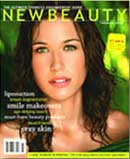
Medical technology and style have converged to elevate cosmetic surgery from a procedure or series of procedures to a comprehensive state of mind. If any proof of this is necessary, consider that several new magazines are being launched dedicated to the lifestyle of cosmetic surgery.


Earlier this year, New Beauty launched with stories about how to select the best spas, how to get rid of wrinkles, "the ultimate guide to breast augmentation," and the latest on laser treatments. A similar magazine, titled Plastique, has launched in Denmark.

Magazines are a bellwether of leading cultural trends, as they live and die by what fascinates the buying public at any given moment. Remember all the Internet-business mags that flourished and folded during the dotcom bubble