FutureWire - futurism and emerging technology

Thursday, September 30, 2004

SpaceShipOne Now 2 for 2

Although this is stale news to anyone following the efforts of SpaceShipOne to capture the X Prize for a successful commercial manned space flight, SpaceShipOne enjoyed a second successful flight yesterday. There were tense moments, however, when the ship began spinning erratically, and the flight was cut short... but not before ascending 67 miles.

SpaceShipOne made its first landmark flight back in July. The next flight is scheduled for next Monday, Oct. 4.

Woman Busted for Loud Cell Phone Call

Depending on your point of view, this story is bound to make you either cheer or cringe. On Sept. 9, a woman who was five months' pregnant was arrested at a Maryland bus depot for talking too loudly on her cell phone. She was forced to lie on her stomach, though a doctor later confirmed that her unborn child was not harmed in the incident. Police claim that she was initially asked by an officer to keep her voice down, whereupon she became "abusive and uncooperative," prompting the arrest.

Having just returned from a business trip and noting how ubiquitous cell phones have become, I can see how they will continue to be a source of friction when used in public places. In part, this is because we haven't yet agreed upon etiquette for using our cool new devices. Although it sounds quaint and hardly futuristic, etiquette is an important concept in any era.

When the telephone was first introduced in the 1870s, it took several years for basic telephone etiquette to emerge. For instance, people didn't know a proper way to answer a phone at first -- something that even small children today take for granted. People also didn't know when it was proper to initiate a phone call, or whether it was too "forward" for women to call men. The wealthy left the task of telephoning to their servants, believing that using the phone was vulgar. Of course, all this reflected the mores and manners of the time, but they illustrate the challenge that the telephone posed to long-established rules of personal interaction.


Cell phones, along with Caller ID, instant messaging, camera phones and text messaging, continue to change the way we communicate with one another. Cell phones in particular have, in part, instigated a loss in privacy as more folks converse out in the open (in the old days, making a public phone call meant going into a phone booth and closing a door). And along with those changes are bound to be conflicts.

Perhaps a resolution will be much like out approach to smoking, in that we divide our public spaces into "phone-friendly" and "phone-free" areas. Or, more locales may take extreme measures, as with Saudi Arabia, which is enforcing a ban on camera phones. The rise of text messaging (along with encryption standards) may permit a return to more discreet personal communication when one is in a public place. At least, one hopes not to be arrested for "texting" too loudly.


In Search of an Ebola Vaccine

Ebola infection is one of the deadliest, most contagious diseases in existence, with no known cure. A single viral particle (pictured below) can multiply and cause death within days. Making matters worse, the Ebola virus has the potential to be weaponized.


Because of this danger, the U.S. Government is making the development of an Ebola vaccine a priority, according to Scientific American. The vaccine appears to be effective in mice and monkeys, but there's currently no safe way to test it in humans. Another unknown is how long immunity will last; current vaccine batches protect for only about a month.

Even though a viable, commercial Ebola vaccine might not be available for years, the Department of Homeland Security may stockpile early versions nonetheless, bargaining that in a bioterror emergency, a questionable vaccine would be better than no vaccine at all.

Monday, September 27, 2004

Video Games: Advertising's New Frontier

Much has been made of ways for advertisers to capture that elusive young male demographic, as they appear to be shunning TV for video games and the Internet. As reported in Business 2.0, advertising agencies are viewing advertising within video games as an increasingly viable option. The "ads" appear mainly as product placements in the background... for instance, a sign on a cab or a side of a bus, or a billboard on a city street. Internet-based games could have ads that update on the fly and promote timely events, such as the premiere of a movie.


In-Game Advertising Spending (in millions)

Measuring the effectiveness of these ads, however, is difficult. Game players may react negatively, and game manufacturers must be persuaded to include the technology for "pushing" the ads in their games. There are no good studies on how impactful these ads are. Unlike advertising for other media, there's no upside for the audience; with radio and TV, at least, advertising subsidizes a "free" service. And, as with any Internet-based technology, there's always the risk for viruses. Game-based advertising, clearly, is in its infancy... but it's worth watching.


Technorati Down This Past Weekend

For all you fellow bloggers our there, if you noticed that traffic to your blogs was down somewhat this past weekend, it might have been because the Technorati blog indexing site was down due to an electrical fire near their host facility on Friday. As of this afternoon, the site was back up but still not at 100%.

Jay Leno to Retire in 2009; Conan Will Replace

Tonight Show host Jay Leno has announced that he will retire in 2009, handing the reins of the late-night legacy to Conan O'Brien. One has to wonder what the face of late-night TV will be like five years hence. On the one hand, Leno and his late-night kin play a large role in forming popular opinion, particularly in political matters. But on the other, network TV appears to be on the decline, under a full-scale assault from cable and broadband Internet.


What kind of media world will Conan inherit? It'll be one that he was a driving force in creating, yet it will also be shaped by uncontrollable outside elements. Will there even be a Tonight Show in 2009, or an NBC? Will the hot new late-night show be on cable, streamed through the Internet, or come to us through some other emerging medium?

More importantly, what will become of Carson Daly???

More X Prize News

As reported here today, the Virgin Group's Sir Richard Branson plans to leverage the technology of X Prize frontrunner SpaceShipOne for commercial suboribtal flights. However, there's more news on the X Prize front to report:
October is shaping up to be a busy month for commerical spaceflight. Hope we see more treats than tricks...

"Nanocarpet" Changes Color, Kills Bacteria

As reported in KurzweilAI.net and Technology Trends, researchers at the University of Pittsburgh have created uniform nanotubes that can be woven into carpet. This "nanocarpet" can be made sensitive to outside agents, allowing it to sense and kill bacteria, and to change color when exposed to certain substances.


(Top) Magnified nanotubes. (Bottom) Nanotubes attacking an E. coli bacterium.
View more pictures here.

Such carpeting would be useful in environments that demand exceptional cleanliness, such as hospitals and homes of people with immune deficiencies, or high-security areas as an early-warning system for bioterrorist attack. It would also be interesting to couple nanocarpet with pressure-sensitive robotic "skin" that detects pressure through a grid of sensors. Could a nanocarpet be engineered to clean itself, to dry itself, to change colors along with decor, and even to repair itself?

Also, from Beverly Tang's reBlog, this same team is working to develop "nano-paint" with similar color-change and antiseptic properties.

Virgin to Pioneer Space Tourism

Virgin chief executive Sir Richard Branson has announced plans to expand into space tourism. Calling his new venture "Virgin Galactic," Branson says that passengers would fly into suborbital space aboard a modified version of SpaceShipOne, which is one of the leading contenders for the X Prize (to be given for the first commercial piloted craft to reach space).


Branson, a noted adventurer as well as an enterpreneur, says that the flights should debut within three years, and that seats will initially go for approximately $50,000 each. Passengers will receive a week's training prior to liftoff; flights will then last for roughly three hours (I know, I know... "A three-hour tour... a three-ho-ur tour...").

IBM, HP Commit to RFID

In a move that indicates the big IT players see radio frequency identification (RFID) as a major emerging technology, IBM and Hewlett-Packard are investing millions into RFID initiatives.

IBM is sinking $250 million and committing 1,000 employees to their initiative, which will help its customers leverage RFID technology more easily. For its part, HP is investing $150 million.

Speculation is that the moves are in response to Wal-Mart's headlong embrace of RFID technology, which is already forcing its suppliers to adopt it as well. Because of its size, Wal-Mart has the luxury of being able to set standards. If RFID proves to be a money-saver, it could open the floodgates for retailers of all sizes to leverage RFID, followed by anybody who needs to track anything electronically.

In addition to big players like IBM and HP getting involved, many smaller software and consulting firms will surely benefit as RFID catches on.

The New York Times Takes on Blogs

The New York Times has an interesting piece today on how bloggers are affecting politics (free registration required to view). Relatedly, Jeff Jarvis' BuzzMachine blog has a piece on how, between blogs and cable TV, he no longer watches network TV. As Jeff says, "I don't consume media anymore; I live it."

Sunday, September 26, 2004

An Approach to reBlogging

One of the strengths of the blogging movement is bloggers' habit of citing and even copying posts from other blogs, virally disseminating and strengthening stories that command attention. Called "reBlogging," it's practiced by many, if not all bloggers (including yours truly). What's called plagiarism in the mainstream media is not only approved of but encouraged by bloggers (including yours truly). ReBlogging is what sets blogs apart from other media... and what gives the blogosphere its unique and growing power.

Tom Moody, an accomplished reBlogger formerly of Eyebeam, has posted his philosophies on reBlogging on his personal blog. While I don't agree wholeheartedly with all his points, he does a very good job explaining what reBlogging is all about, and why it's important. If you're not familiar with reBlogging, reading this post -- along with the comments it's collected -- is an excellent starting point.

Friday, September 24, 2004

Terrorism Survival Guide

The RAND Corporation is making available, at no charge, a downloadable guide to preparing for and surviving a chemical, nuclear or biological terrorist attack. The guide comes in PDF and Palm OS versions.

And on that cheerful note, have a nice weekend! :)

Another One Bites the Dust

Interstate Baking Corp., the bakery responsible for Twinkies, Wonder Bread, and other confectionary delights, has filed for Chapter 11 bankruptcy protection. Among the reasons stated for the move were declining sales, igniting speculation that Americans' move toward lower-carb diets was to blame at least in part.


If so, it wouldn't be the first time that the low-carb craze has hurt traditional food retailers. In May, New World Pasta, which makes San Giorgio and other pasta brands, also filed for Chapter 11. And the Krispy Kreme donut chain has been struggling for the past several months.

All these closures point to a fundamental shift in our eating habits. What foods are more American than Twinkies and Wonder Bread (except maybe for apple pie)? For the maker of these staples to go belly-up (pun only partially intended) suggests that the Atkins-inspired low-carb movement is no mere craze. In fact, we may be witnessing the most profound change in diet since processed foods, frozen foods and supermarkets arrived en masse after the end of World War II. Seems like we're finally starting to put our health -- or at least our physiques -- ahead of our taste buds.

Thursday, September 23, 2004

Naked Yoga in San Francisco: Round 1?

CNN reports that a California court ruled that a nude yoga practitioner could do his thing in public in San Francisco... even in the tourist-crowded Fisherman's Wharf area. What's important here is not that San Franciscans can now practice yoga with nothing but their mats, but that California has essentially stated that public nudity in of itself is not a crime.

This could lead to even more interesting court cases on public nudity, followed by challenges from conservatives and moralists. The outcome in California may determine whether this is the start of a national trend and yet another battle in the culture wars.

If It Seems Too Good to be True...

When Oprah gave away cars this past week to members of her studio audience, it was lauded as an incredible act of generosity. Well, not so fast. Turns out that the media maven neglected to pay taxes on those cars... sticking some of those recipients with tax bills as high as $7,000. Some gift!

Seems like the biggest beneficiary of that stunt was Pontiac, whose website saw a spike in traffic after the Oprah episode (the cars she "gave away" were Pontiac G-Sixes). Meanwhile, MSNBC's Countdown has a video clip on the trend toward "extreme advertising" that takes increasingly creative -- and often bizarre -- approaches in grabbing our attention. I've written about this trend here before. Also, check out this piece from Money magazine on "ass-vertising," "bra-vertising" and "dog-vertising." Don't ask, just read the damn article...

(MSIE 6 and Microsoft Media Player required to view the video clip)

More on Bloggers as Scoop Journalists...

MSNBC has an interesting piece on its "Hardblogger" blog on the "why" and "how" of bloggers scooping the big news stories. A blog called My Due Dilligence has a piece claiming that the top political blogs have readerships that match or surpass that of the cable news websites.

Wednesday, September 22, 2004

The World's Most Dangerous Ideas

Foreign Policy, a website run by the Carnegie Endowment for International Peace, has published an article outlining what some of their contributors feel are the world's most destructive ideas over the next few years. Some are obvious, while others are quite curious in the least. They are:
  • War on Evil (or rather, the concept of evil)
  • Business as Usual at the U.N.
  • Transhumanism (for more information, go here)
  • Free Money (i.e. deficits and debt)
  • Undermining Free Will
  • Spreading Democracy (through nondemocratic means such as war)
  • Religious Intolerance
  • Hating America (or, at least, hating American values such as freedom and individualism. Plus, people who really hate America tend to get bombs dropped on them...)
Exactly how dangerous these ideas really are will surely be fodder for debate for some time. Particularly interesting is the inclusion of transhumanism on the list... which shows that a concept of interest to many futurists is showing up on other people's radar screens.

Death Becomes Them...

A little over a month to go before Halloween, and already we have two unorthodox ways of remembering loved ones in the heareafter. Both were reported by Bevery Tang's ReBlog:


Back in August, I reported on Costco's move to sell caskets, which is a startling yet rational response to the high cost of funerals these days, as well as the wisdom of preplanning. But the above-mentioned procedures were hardly cheap... and suggest new and creative ways in which we honor our dead. Perhaps in 10 years, people will read these stories and be surprised that they were once categorized under "weird news."

Just a Spoonful of Sugar Makes the Milky Way Go 'Round...

Astronomers have found, of all things, a cloud of simple sugars near the center of our Milky Way galaxy. The cloud of glycoladehyde (a.k.a. two-carbon sugar) molecules is about 26,000 light years away, and is frozen to just a few degrees above absolute zero. Aside from the weirdness factor, astronomers are interested in this cloud because it suggests that the basic building blocks of life may have originated in interstellar space. Two-carbon sugar, after all, is one of the building blocks of DNA. Theoretically, comets and other interplanetary wanderers could pick up these sugars and "seed" planets with life-generating compounds.

But the truly important question is, does this mean the Milky Way isn't low-carb???

Researchers Create Robotic "Skin"

When imagining robots, we give them many human attributes. Skin is not usually one of them. That's because we tend to take our skin for granted, though it constantly provides us with important feedback -- from pain, heat, cold, and touch -- that helps us function.

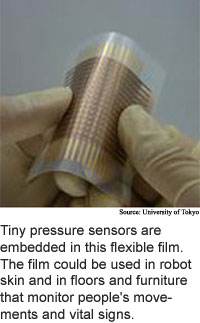
Now, scientists at the University of Tokyo have created a flexibile film filled with pressure-sensitive arrays that would provide a robot or some other device with a sense of touch. Such "robot skin" would help robotic arms manipulate with greater precision, and could be used in other applications such as "smart" flooring and furniture.


The uses of such skin are endless. As part of a pervasive computing environment in hospitals, for instance, the skin could be incorporated in flooring (to detect if a patient has fallen) or bedding (to monitor vital signs). Skin could also be added to gym equipment to provide a rich array of feedback, and to car seats to determine whether a driver is fit to take to the road.

The University of Tokyo researchers hope to have a commercially viable version of their robotic skin ready within four to five years.

Tuesday, September 21, 2004

Voter Tools and Resources Page

Regular readers of this blog know that during this campaign season, I've been posting Internet-based resources for voters. For handy references, I've collected some of the best resources on a single page, at http://www.futurewire.net/articles/voter_tools.htm
Suggestions for new tools and resources are appreciated; you can e-mail them to me at info@futurewire.net

Franken-Grass!

With fall approaching, now is not the time of the year most folks are thinking about grass. But Monsanto and Scott are... they're developing what's being called the world's first bioengineered grass.

The strain of creeping bentgrass is resistant to herbicides such as Roundup (which, as anyone who has ever used it knows, is incredibly deadly to any form of plant life). The idea is that groundskeepers could spray lawns with very harsh pesticides to kill all weeds, and leave the grass unscathed. Version 1.0, as it were, would be designed for golf courses, but Monsanto and Scott are developing versions for home lawns as well.

However, environmental groups, the U.S. Forest Service and the Bureau of Land Management are quick to point out the downside of "franken-grass," claiming that it could become a "superweed" that could spread uncontrollably and crowd out other plantlife. An article set for publication in the Journal of the National Academy of Sciences points out that the grass has unusually light pollen, allowing it to spread more widely than regular grass pollen.

Monsanto and Scott counter that bentgrass is not known to spread uncontrolled, though no studies have conclusively proved or disproved that such grass can spread unchecked. Biologists note that bentgrass can cross-pollenate with other strains, though Monsanto and Scott say that this particular strain does not.

The next step is more thorough Dept. of Agriculture testing, which could take a year or more. In that time, expect to hear lots of arguments for and against genetically modified grasses.

Are Cell Phones Screwing Up Polls?

You've surely heard about the wide discrepancy in some of the recent surveys for the Presidential campaign, with some showing a dead heat between Bush and Kerry, while others give Bush a comfortable lead. One intersting explanation is that pollsters are missing out on a significant bloc of voters: those who have cell phones but no land line. FCC rules prohibit pollsters from making unsolicited calls to mobile phones. However, the number of people--young adults, mostly--who opt for a mobile phone instead of a land line is growing. New rules allowing cell phone customers to keep their numbers will likely exacerbate this trend, making phone-based random surveys less and less reliable.

This issue confounds pollsters in another way. Because they must omit any number that might be a cell phone, pollsters are less able to use automated dialing systems, returning to manual dialing. This was my first job out of college... and believe me, it was no fun!

So what's the solution? Some have proposed a national opt-in list that would give pollsters permission to call cell phones. Others are suggesting a return to door-to-door and "man on the street" polling. I can't imagine any of these solutions being successful this day and age.

Pollsters, by the way, are exempt from restrictions imposed by the federal Do Not Call Registry.


[NEW FEATURE] Link-Worthy Sites

Visitors to the Web version of this blog can see, when scrolling down the right-hand column, a list of "link-worthy" futurist and/or emerging technology websites and blogs. Since I began this project this past summer, I've been collecting a list of these "best of the best" resources, and thought it only proper that I share them. Suggestions for new resources are always welcome; just drop me an e-mail.

Monday, September 20, 2004

[BREAKING NEWS] CBS To Retract Bush Memos

CBS News reportedly plans to issue a statement today claiming it was "misled" on the memos that supposedly showed that President Bush received special treatment while in the National Guard. Not yet clear, however, is whether CBS will actually apologize for insisting the memos were authentic, or precisely where the memos came from. MSNBC has a story on the retraction here.

As we mentioned earlier, bloggers were among those who first suggested that the provocative memos may be fake.

Friday, September 17, 2004

"Digital Divide" Narrows for Kids

Good news for kids using the Internet: The Henry J. Kaiser Family Foundation has released a study saying that nearly all U.S. kids (96%) have gone online at least once. The report also notes the growing number of low-income children who have been able to log on. It's especially positive when compared with a 2001 U.S. Department of Education study finding that only 60% of students had been online.

However, the report found disparities remaining. Income was the deciding factor in how often kids used the Net: 70% of children from families earning more than $50,000 annually went online regularly, while only 54% of children from households earning less than $35,000 were regular surfers. This is likely because children from lower-income households were dependent on school and library terminals, where access times are limited, for their Internet access, whereas wealthier children benefitted from having computers in the home.


Reverse Auctions for Jobs

Could we be approaching a workplace future where we apply for jobs by bidding on them on eBay?

Maybe not... but online auction markets for jobs is a distinct possibility, and is already being used in certain areas. One Massachusetts hospital has implemented an online system allowing nurses to reverse-bid on extra overtime hours. The hospital posts the shift and the top rate it's willing to pay, and the lowest bidder wins. So far, the system seems to be working out well; the hospital is filling open shifts in a cost-effective manner, and the nurses are able to pick up overtime at a decent rate and at times convenient to them.

Web-based job-matching systems for consultants and freelancers, such as Guru.com and eLance.com, have been around for some time, and of course we're all familiar with job search sites such as Monster.com. But perhaps this is a sign that market-based job systems are finding their way into the mainstream. If, as many economists and management experts believe, we're becoming a "freelance nation" in which we all move from job to job as we complete individual projects, systems such as these will become essential.

In Search of Political Truth

For those who feel "political truth" is an oxymoron, bear with me...

In our continued coverage of how the Net is changing the political landscape, FactCheck.org deserves special mention. Supported by the nonpartisan Annenberg Public Policy Center, FactCheck seeks to clear up the disinformation contained in much of today's political advertising and candidate statements. A free newsletter containing the latest updates is also available.

Neither political party is immune from FactCheck's watchful eye. FactCheck even seeks to debunk political rumors and urban legends swirling around the Internet. Journalists and political scientists are finding FactCheck to be an invaulable tool -- a fact that speaks volumes about the lack of objectivity in the current political sphere.

Thursday, September 16, 2004

More on Smart Phones as the Killer App

In my last post I noted that cell phone users are now able to use their phones to store music and image files. An article in the New Scientist elaborates on this theme, describing how Nokia is developing a file-sharing network that would allow phone users to swap files. Nokia is working on the assumption that these files could be in the gigabyte range, to accommodate videos. And, as you might expect, the music and film industries are not pleased. Nokia remains confident that it can overcome any opposition they pose.

There's Gold in Them Thar Ringtones!